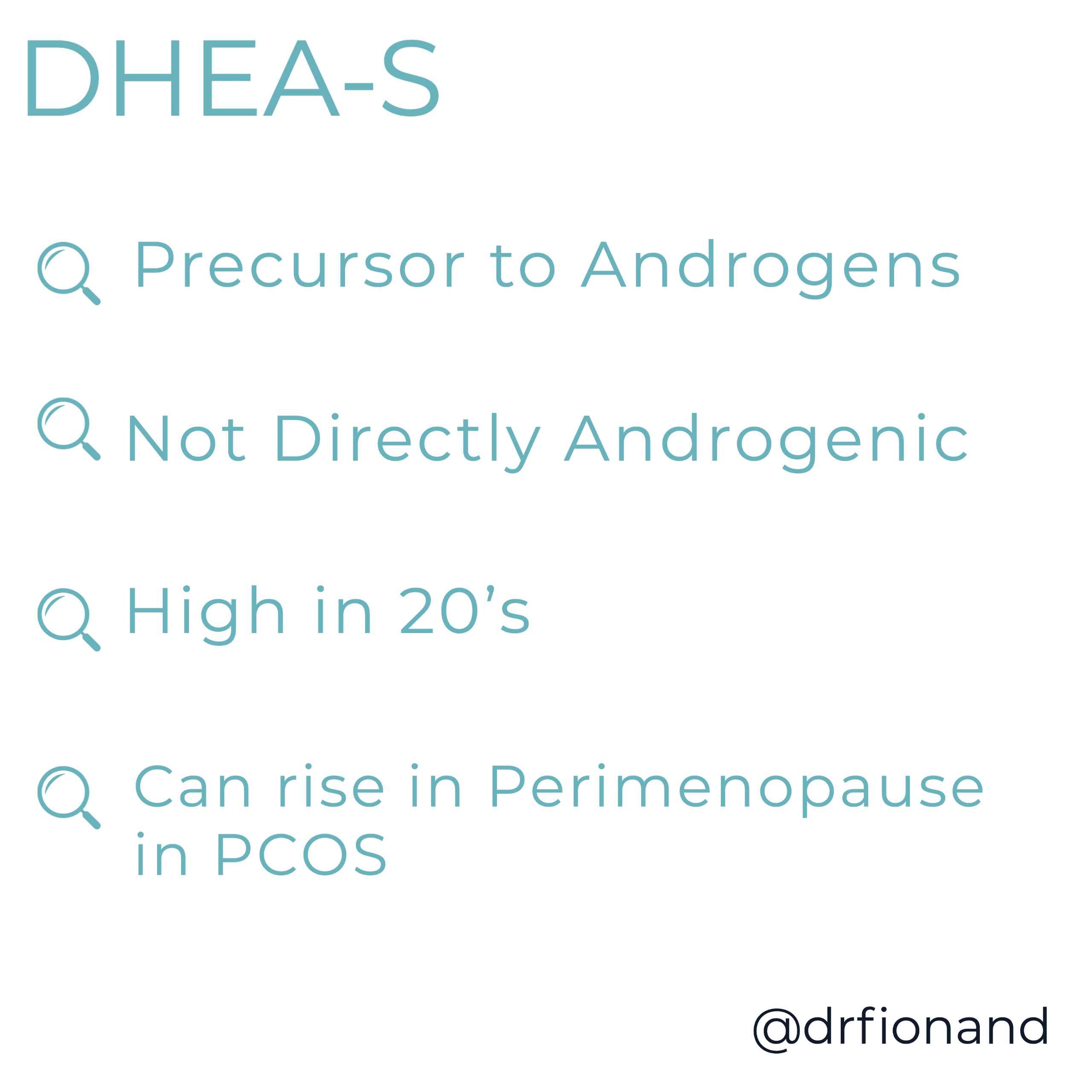
The first thing to know is that DHEA-S is an androgen precursor, not the same as a direct androgen like testosterone.
It converts into true androgens like testosterone but doesn't occupy the androgen receptor itself, so its androgenic effect comes after conversion.
DHEA-S is a hormone that depends on a patient's age. It is high in the mid-20s and decreases through life. At the clinic, we read a DHEA-S level against age, confirm it rather than work from a single draw, and interpret it with the other markers beside it.
Some patients have levels that are within normal range, but high for their age. Other patients have levels just slightly above the range in their 20s, which is very common across PCOS presentations. And other patients have extremely high levels, far above the range. All of these have different meanings.
CONO Registered
Peer reviewer, 2023 International PCOS Guidelines
Established 2002
A Lab Result Showing High DHEA-S
Most patients who are asking about this find it through a lab report, where DHEA-S is flagged or sits just under the top of the range. Unfortunately nothing is attached explaining what this means or changes.
On researching this, most patients encounter three different accounts: blogs and videos describing high adrenal androgens as a separate PCOS picture with its own protocol, and a verdict that the value is in range and not worth discussing. Even the labs themselves are confusing, as their ranges read the same at every age and aren't adjusted for it.
Some patients find out they have this issue when they notice facial hair or hair thinning at the crown from the late 30s or 40s. Then labs return a high DHEA-S level, but they've never been diagnosed with PCOS in the past. Looking this up, they've landed on a page about PCOS and wonder how they arrived here.
What DHEA-S Actually Is
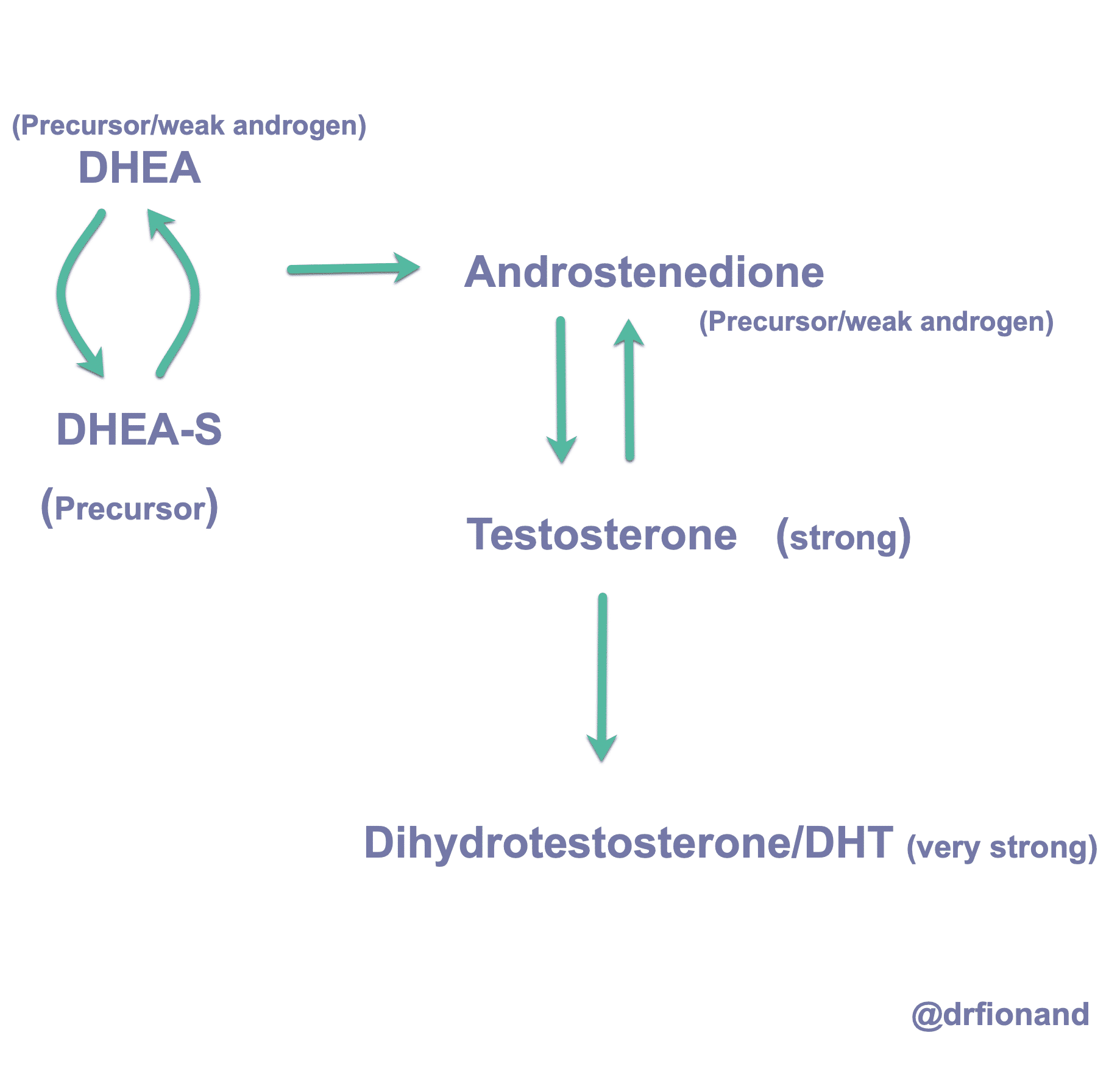
DHEA-S is a precursor. It functions mostly as a substrate that can be turned into other hormones.
DHEA-S can be converted into true androgens like testosterone
DHEA-S doesn't fit into the androgen receptor causing androgenic effects, whereas testosterone does
DHEA-S is androgenic primarily when converted to direct androgens
Here's the important part. In some younger patients, after successfully treating PCOS, I often see levels of testosterone or androstenedione decline dramatically. Yet DHEA-S levels don't seem to drop to the same degree as the other androgens. That's right, even when treating the adrenals and normalizing cortisol levels! And yet, these patients see major improvements in their cycles and androgenic symptoms.
This is because, again, DHEA-S is a precursor and not a powerful direct androgen like testosterone. Even when a patient has adrenal androgen excess, it is critical to also focus on ovarian hormone production in order to bring the entire state to balance. Adrenal androgens are an important factor in PCOS, but their role needs to be understood and treatment applied accordingly.
Androstenedione vs DHEA: Two Precursors, Not Two Androgens
DHEA and DHEA-S sit upstream. Their androgenic effect depends on what they are converted into.
Adrenal androgen excess is almost always associated with the ovary/brain cycle in PCOS, meaning that the ovary uses DHEA-S under the command of LH, a brain hormone, to create testosterone.
From 25 years of experience in practice, it is a mistake to exclude the ovary and focus only on treating the adrenals in these patients. The entire cycle of PCOS must always be treated (see my post on the cycle of PCOS) to create a significant shift in the hormonal state.
DHEA-S in PCOS: What Makes a Level Interpretable
Four things make a single DHEA-S value mean something.
Read Against Age, Not as an Absolute
DHEA-S peaks in the mid-20s and declines from there, so a level that is normal at age 25 can be meaningfully high at 45. It's common for a DHEA-S level to be high for age and not be above the range.
Confirmed, Not Single
DHEA-S levels should be repeated a few times to gain a full understanding; until then, the report holds a data point rather than a pattern. In PCOS, sometimes DHEA-S levels will rise temporarily from stress.
Mildly Elevated Versus Markedly Elevated
Markedly high DHEA-S draws more clinical support to the hypothalamic-pituitary-adrenal axis; mildly high DHEA-S is very different. Mildly high DHEA-S is actually very common in all patients with PCOS, especially at younger ages. When we see this we work on the factors driving conversion of DHEA into testosterone, since conversion to strong androgens and not the precursor produces PCOS symptoms. Adrenal-dominant presentations with very high DHEA-S have been found to carry less insulin resistance, though this isn't always true.
With time and research it seems that high adrenal androgens in PCOS now read as less of a separate clinical picture than they once did. In the newer research-based subtypes of PCOS, adrenal androgen excess falls inside the high-androgenic group rather than separating out on its own. In addition, the approaches used for androgen excess generally work well for adrenal-dominant PCOS patients. Assessing individually, including a patient's history, her response to stress, and the rest of her hormonal picture, is essential for every PCOS presentation.
Never Read Alone
DHEA-S is read alongside testosterone, androstenedione, SHBG, FSH, LH, cortisol and other hormones where indicated. Across PCOS presentations the treatment varies from patient to patient, and includes a comprehensive lab and clinical review.
DHEA-S Levels by Age, and Why Some Rise in Perimenopause
Since DHEA-S levels peak naturally in the mid-20s and decline with age, we commonly see increased levels in young patients, although commonly there is another rise in perimenopause in PCOS.
In some patients DHEA-S is simply always high; in others it's high only while they're young and comes down with age; in a third it rises only in perimenopause and menopause.
A single value against a flat cutoff is a lot less insightful than the big picture.
The third group of perimenopausal and menopausal patients we see at the clinic with high DHEA-S is relatively small, and it includes women never diagnosed with PCOS. They often present with symptoms all of a sudden: facial hair popping up in perimenopause or menopause, or androgenetic alopecia, female pattern hair loss. When their levels are checked, DHEA-S is elevated, and some of them had no PCOS markers at all beforehand.
SHBG, a testosterone-binding protein produced by the liver, also moves on the same timeline. It often runs low as women reach their late 30s and 40s, from insulin resistance, and that leaves more testosterone free to act on skin and hair. That's one reason we assess SHBG and testosterone alongside DHEA-S rather than DHEA-S alone.
What a Standard Workup Does With a DHEA-S Result
A GP or endocrinologist typically orders DHEA-S within a broader PCOS, androgen or hirsutism workup, and usually alongside testosterone. It's read against the single population reference range on the page.
That range comes from a reference population and is calibrated to flag overt, established disease, which it does. It isn't built to separate a value unremarkable at one age from the same value at another, or to identify a one-off reading from a recurring pattern.
Age-referencing, repeat confirmation, and the mild-versus-marked distinction are important parts of a workup for high adrenal androgens in PCOS, or adrenal androgen excess.
What This Looks Like at Our Clinic
At an intake, we review DHEA-S alongside FSH, LH, testosterone, androstenedione, SHBG, cortisol and other hormones where indicated.
The perimenopausal rise is a recognized pattern we have seen many times, but in general this happens only in a small number of patients. We don't actually know why. It may be genetic, it may be stress-related, but we need to do more research.
Our assessment is comprehensive and can uncover a variety of underlying causes and factors in situations such as these.
Who Wrote This
Dr. Fiona McCulloch, ND is the published author of 8 Steps to Reverse Your PCOS (2016) and served as a peer reviewer of the diagnostic section of the 2023 International PCOS Guidelines. Androgen interpretation in PCOS sits inside that work.
She wrote on adrenal androgen excess in PCOS for Naturopathic Doctor News & Review in February 2015; that article is located on our treating adrenal androgen excess page.
We haven't found exercise to be a problem for patients with higher DHEA generally. Some avoid it anyway, expecting that anything raising cortisol will raise DHEA-S with it. For patients who don't have this pattern, stress doesn't really affect DHEA-S, and cortisol going up is completely normal rather than something to guard against. What limits these patients is more often reduced exercise tolerance from burnout, stress, or insulin resistance, which working up gradually addresses.
Is DHEA-S the same thing as taking a DHEA supplement?
No. DHEA-S is a hormone the body makes and a lab measures; DHEA taken as a supplement is a separate question, covered on DHEA, androgens and egg quality.
Does a high DHEA-S mean I need a different treatment approach?
Largely no. Where the elevation is marked, the hypothalamic-pituitary-adrenal axis takes up more of the clinical attention; where it's mild, the work goes to whatever is driving the conversion into testosterone. Past that, an adrenal-dominant androgen pattern is approached the way androgen excess generally is, a shift from how it was once understood. Detail sits on the adrenal androgen excess page.
Can you have high androgens without having PCOS?
Yes. A small group of women develop DHEA-S elevation for the first time in perimenopause or menopause, with hirsutism or androgenetic alopecia appearing suddenly and no PCOS markers in their history.
How often should DHEAS be retested?
Levels should be repeated a few times to gain a full understanding.
References
McCulloch, F. PCOS – Treating Adrenal Androgen Excess. Naturopathic Doctor News & Review, February 2015.
Written by Dr. Fiona McCulloch, NDMedically reviewed by Dr. Fiona McCulloch, NDLast reviewed: August 19, 2026
Naturopathic assessment of PCOS and adrenal androgen patterns is available in-person at our North York clinic and by telemedicine for patients across Ontario. To work through your own panel with a practitioner, you're welcome to book a consultation.
widget: telemedicine-ontario-badge
Ontario Map Image
For Telemedicine appointments, you must be in Ontario at the time of your visit.
Please do not book a telemedicine appointment if you are unable to do this.
Both Dr. Fiona and Dr. Alex see patients for naturopathic PCOS and hormone assessments. Dr. Alex currently has immediate availability; Dr. Fiona typically books 2-3 weeks out. Fee details and booking links are in each card below.
widget: practitioner-fiona
FM
Fees for Dr. Fiona McCulloch, RAc, ND
Author of 8 Steps to Reverse Your PCOS. PCOS Advisory Board member and peer reviewer of the 2023 International Evidence-Based PCOS Guidelines. 25 years clinical focus in hormonal health, thousands of patients assessed.
Care using the same clinical framework as Dr. Fiona. For complex or challenging cases, Dr. Alex has direct access to Dr. Fiona's guidance — so you benefit from that depth of expertise regardless of which practitioner you see.