
How to Test for Insulin Resistance

Have you been told that your Blood Sugar and HBA1C is Normal and therefore are not insulin resistant? In most medical practices, it is typical to test patients for blood markers of diabetes. Unfortunately, this type of thinking is rather dangerous as the vast majority of people who exhibit signs and symptoms of insulin resistance test negative for diabetes!

This guide is dedicated to Dr. Joseph Kraft MD, a pioneer in the development of laboratory assays to accurately test for insulin resistance before the development of diabetes. The amazing Dr. Kraft just recently passed away in 2017 at the age of 95. His contributions to the field of metabolic and cardiovascular health were under-appreciated during his time but have vast implications today!

  • CONO Registered
  • Licensed to order laboratory testing in Ontario
  • Established 2002
Woman sitting at home looking thoughtful while using a laptop

What Are the Signs and Symptoms Of Insulin Resistance?

Even though you may have been told your blood sugar is normal, if you are noticing some signs of metabolic issues that point to insulin resistance – it’s important to investigate a bit deeper.

These signs are:

Why are so many patients with these clear signs and symptoms of insulin resistance testing negative for the most common assays for diabetes?

The answer is simple! The wrong tests are being recommended. You are completely right to want to look a bit deeper for answers.

Why normal blood sugar result doesn't settle the question

And, What’s the Difference Between Diabetes and Insulin Resistance?

Rather than a condition that develops overnight, the onset of type two diabetes is a lengthy process that takes many, many years to manifest. It begins with insulin resistance, often starting decades before the high blood sugar levels characteristic of a diabetic emerge.

Insulin resistance is characterized by hyperinsulinemia – the secretion of higher than normal amounts of insulin either after eating, or continuously even when fasting. Insulin is an important hormone – without which we would quickly die. It is released after we eat, and tells our bodies what to do with the energy we consume. Insulin directs glucose into storage within our cells and blocks the breakdown of fat since there is already abundant energy in the bloodstream after a meal. This natural, healthy process can go wrong through genetic susceptibility or if we gain significant weight.

As cells accumulate excess energy or through predisposing genetic factors, they become less sensitive to insulin’s message. The pancreas must then produce increased amounts of insulin in order to manage blood sugar effectively. Unfortunately, we can secrete high amounts of insulin and have quite normal blood glucose for some time – this is because increased levels of insulin can “work overtime” keeping the blood sugar from climbing too high. Unfortunately, having unusually high amounts of insulin after eating, or when fasting does have negative health impacts on our metabolism, hormones and cardiovascular systems.

The first documented effect of chronically elevated insulin is change in the arterial wall, an insulin-sensitive tissue (Stout, 1979). Retinopathy has been documented years before a diabetes diagnosis was made, placing the onset of the disorder well ahead of any glucose threshold (Harris et al., 1992). Cardiovascular complications account for the large majority of deaths in type 2 diabetes (Reasner, 2008). Detecting the pattern before a glucose-only workup flags a problem contains a highly meaningful clinical question.

How To Test for Insulin Resistance or Hyperinsulinemia

First, here are the most commonly completed tests for metabolic health, many of which will not pick up insulin resistance. That said, it’s important to understand the background when you want to understand which tests to request and why.

Abstract illustration representing hidden health factors beneath the surface

Fasting Glucose

A simple test of blood sugar measured after an overnight fast, this is a measure particularly good at picking up diabetes. Levels above 5.5 mmol/L (99 mg/dl) indicate a higher chance of diabetes. There are however many, many individuals with normal fasting glucose who have significant insulin resistance and pre-diabetes.


HBA1C

This blood test approximates your average blood sugar for the past 2-3 months, meaning it does provide us with some good information on glucose control. It measures the percentage of blood sugar attached to hemoglobin (the protein which carries oxygen in your blood cells). The higher your blood sugar levels on average, the more hemoglobin you’ll have with sugar attached to it. An HBA1C between 5.6 and 6.4 indicates pre-diabetes. Above 6.5 indicates likely diabetes. It is important to note that patients with iron deficiency anemia can have falsely elevated HBA1C levels.

Oral Glucose Tolerance Test

The Oral Glucose Tolerance Test is commonly prescribed to detect diabetes, yet again it will rarely be able to detect insulin resistance or hyperinsulinemia. For this test, patients fast overnight and then their fasting blood sugar is measured. A sugary liquid is consumed and blood sugar levels are then measured at intervals over the next two hours. Blood sugars less than 7.8 mmol/L (140 mg/dl) are considered normal. A reading of over 11.1 mmol/L (200 mg/dl) after two hours indicates diabetes. Between 7.8 mmol/L and 11 mmol/L suggest that a patient has pre-diabetes. Many patients with insulin resistance will have completely normal glucose tolerance tests and passing this test does not mean your metabolism is healthy!

As previously mentioned, the majority of those who have metabolic problems and insulin resistance will test within the normal range for all of the above markers.

In PCOS, a condition where high levels of insulin cause the ovarian theca cells to release high levels of testosterone and other androgenic hormones, it is helpful to know the degree to which hyperinsulinemia is present. Often, women with PCOS have completely normal blood sugar levels, and can often have low blood sugar levels as well. Yet, their metabolisms may be significantly impaired.

Fasting Insulin

Fasting insulin is a relatively inexpensive and easily accessed test but unfortunately, it is not often ordered by physicians. Patients with moderate or severe insulin resistance will often have an elevated fasting insulin level.

According to the NHANES III Survey, the average insulin level in the U.S. is much lower – is 8.8 uIU/mL for men and 8.4 for women (Maureen I. Harris et al., 2002).

Although fasting insulin is a good screening test for severe insulin resistance, it is often not enough to pick up moderate or mild insulin resistance. As we will see through the work of Dr. Joseph Kraft, a pioneer in the development of insulin assays, many people with normal fasting insulin and exhibit comparatively high insulin responses after eating.

HOMA2 (Homa-IR)

The Homa2 is a mathematical calculation based on the ratio between fasting insulin and fasting glucose. It is able to give an approximation of insulin resistance as well as pancreatic beta cell function (which is often impaired as type two diabetes begins to develop). The HOMA2 correlates well with the euglycemic clamp method which is a tested research method to determine insulin resistance (and which is not practical for clinical use).

Information required to calculate HOMA2:

Normal values: are often under 1.5 for very metabolically healthy individuals. Mild insulin resistance may result in levels between 1.5-2.0. The higher the number the more insulin resistance.

C-Peptide

C peptide is a molecule that can reflect endogenous production of insulin as it is linked to insulin when it is first produced. C- peptide is not often tested except in those suspected of having type 1 diabetes however it can also be a surrogate marker of insulin resistance as levels can be higher than normal.

Normal values (fasting) : range from 0.51 – 2.72 ng/mL

Triglycerides

Of the lipid panel, triglycerides tend to be the most specific marker of insulin resistance. A common cause of high triglycerides is excessive consumption of carbohydrates, particularly refined carbohydrates and sugars. When the liver has sufficient energy stored in the form of glycogen (carbohydrate) any additional glucose is shunted into the production of fatty acids which fat cells use to synthesize triglycerides. As such, triglycerides can be raised from overconsumption of energy (calories) and of carbohydrates. As insulin also inhibits the breakdown of triglycerides from fat cells, insulin resistance is linked with the accumulation of triglycerides in fat cells.

Normal values:

  • Normal — Less than 150 milligrams per deciliter (mg/dL), or less than 1.7 millimoles per liter (mmol/L)
  • Borderline high — 150 to 199 mg/dL (1.8 to 2.2 mmol/L)
  • High — 200 to 499 mg/dL (2.3 to 5.6 mmol/L)
  • Very high — 500 mg/dL or above (5.7 mmol/L or above)

The Most Detailed Test for Insulin Resistance: Insulin Assay with Oral Glucose Tolerance Test

There’s no best test for insulin resistance independent of the person being tested, so the decision comes down to what makes the most sense for the situation. HOMA-IR is the lower-burden default: one fasting blood draw, no glucose drink, no multi-hour appointment, and it doesn’t need as many details to run.

By far, the most detailed test for insulin resistance, hyperinsulinemia and other blood sugar dysregulations is the Insulin Assay with Oral Glucose Tolerance test, also known as the Kraft Test or insulin glucose challenge.

We frequently order this test for our clinic patients (we call it the Insulin Glucose Challenge in our practice). In typical medical practices, this test is rarely completed yet it can provide a great deal of insight into a person’s metabolic function for decades before diabetes develops.

Dr. Kraft was a pathologist who completed over 3000 autopsies, and incidentally found atherosclerosis in every person over 40 years of age, at which point he became quite interested in how this came to be. He found that the slow development of atherosclerosis was linked primarily to insulin resistance and hyperinsulinemia.

Dr. Joseph Kraft ran the insulin assay with oral glucose tolerance test on 14,384 patients and then compiled and published his groundbreaking results which we can use today to learn a great deal about our metabolic health.

The Insulin Glucose Challenge: the insulin assay with an oral glucose tolerance test

How Does the Insulin Assay with Oral Glucose Tolerance Test Work?
In a similar manner to the oral glucose tolerance test, the patient fasts overnight and then completes fasting blood work. The main difference is that at each interval during the 2 or 4-hour span of the test, insulin is measured along with glucose. This provides great insight into patterns of insulin resistance. Not only can the fasting levels be checked, but increases in insulin production when stimulated by glucose are easily seen. Causes of low blood sugar can be understood as clear patterns of hyperinsulinemia and reactive hypoglycemia (severe drops in blood sugar 2-4 hours after eating) are picked up by this test. In addition, a phenomenon called gastric dumping (a cause of reactive hypoglycemia) can be determined through observing specific patterns in insulin release and glucose levels over the span of the test.

The 4 Stages of Insulin Resistance in Increasing Order of Severity on the Insulin Glucose Challenge Test

(Ref: J. R. Kraft, 2011)

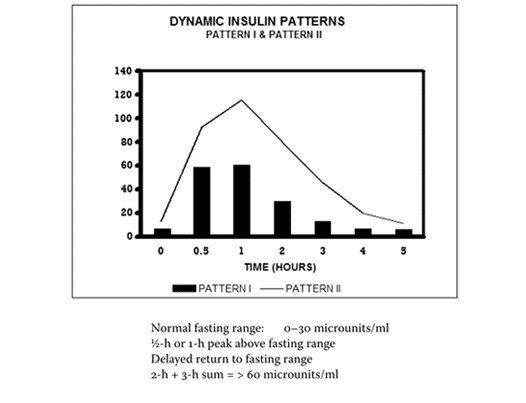
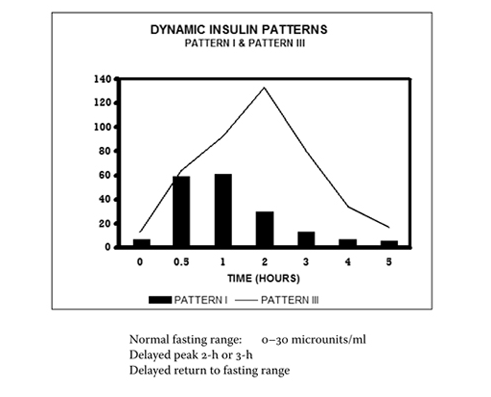
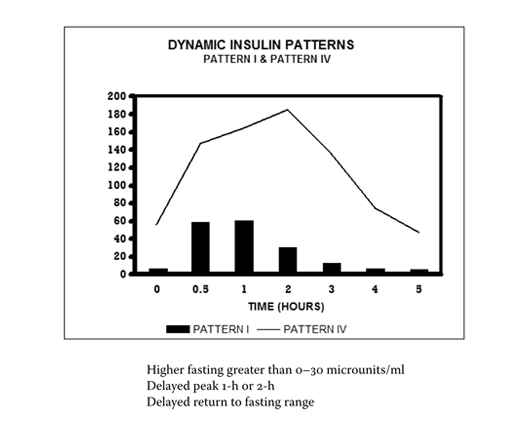
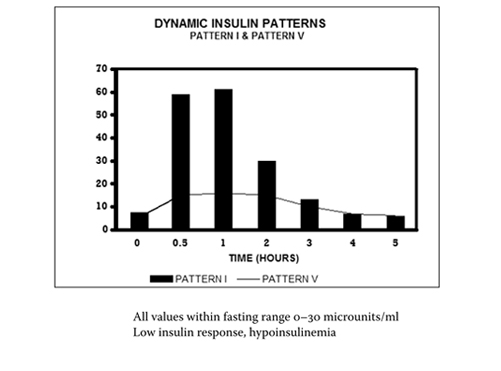
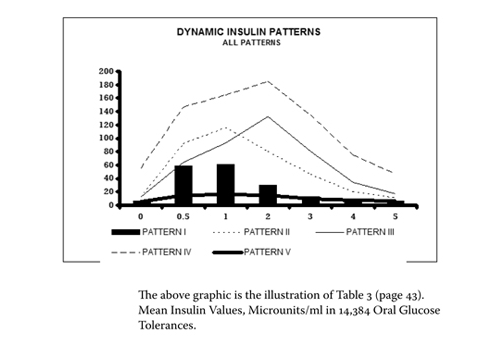
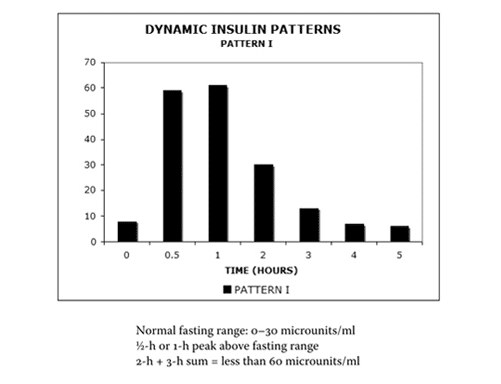
Pattern 1 represents normal insulin signaling. Note the quick rise to maximum insulin at 0.5 to 1 hour after the consumption of the glucose beverage. Insulin levels then quickly drop down to fasting levels.

Pattern 2 Represents Hyperinsulinemia. Note that the overall levels of insulin secreted are far higher than found in pattern 1. In addition, the peak rises prominently at 1 hour and then there is a striking delay in returning to the fasting level.

Pattern 3 also represents Hyperinsulinemia however it is more marked than pattern 2. There is a striking peak in insulin by 2-3 hours. Often in these patients, there is also impaired glucose tolerance during the test (elevated blood glucose).

Pattern 4 Includes Hyperinsulinemia with impaired glucose tolerance. Note the levels here are exceptionally high with a 2-3 hour sum of insulin over 320 microunits/ml (1920 pmol/L)

Pattern 5 represents Hypoinsulinemia, often with impaired glucose tolerance. This pattern occurs just prior to the development of autoimmune type 1 diabetes.

This is a summary of all insulin patterns superimposed, to highlight the striking differences in insulin release for the hyperinsulinemic patterns.

Reading a HOMA-IR result

The published formula is fasting insulin multiplied by fasting glucose, divided by 22.5, with fasting insulin reported in µIU/mL.

A value under 1.5 is metabolically healthy, 1.5 to 2.0 as mild, and the higher it climbs the greater the insulin resistance.

There’s a practical complication for anyone running the arithmetic on their own report: Ontario laboratories report fasting insulin in pmol/L, and the formula above assumes µIU/mL.

Waist to Height Ratio: The measurement that doesn't need a lab test

A completely free yet accurate marker of insulin resistance is the waist to height ratio. This is incredibly simple to calculate as it is the waist circumference divided by height in the same units. A 2010 study following 11,000 subjects for 8 years found that WHtR was a better measure of the risk of heart attack, stroke or death (Schneider et al., 2010). Another study in 2016 followed 754 reproductive age women found that Waist to Height Ratio was a good predictor of Insulin Resistance and metabolic syndrome in women with and without PCOS (Behboudi-Gandevani, Ramezani Tehrani, Cheraghi, & Azizi, 2016).

Waist to height ratios over 0.5 are considered to be exceptionally risky when it comes to metabolic health. We encourage all patients to measure this ratio, as it is completely non-invasive and can be done at home.

What Information This Testing Provides

The insulin glucose challenge is done at standard labs and are considered traditional labs.

This can be used alongside traditional tests, body composition analysis to provide a complete picture. The Kraft test can provide insight into insulin resistance that isn’t detectable with other methods as well.

Getting an insulin resistance test in Ontario

Naturopathic doctors in Ontario hold laboratory-ordering authority, and in our practice we often order fasting insulin, the companion panel that goes with it, and the Insulin Glucose Challenge. The route is an ordinary laboratory requisition at Lifelabs or Dynacare.

In order to access testing we complete the following for patients:

  1. A case review and a full symptom review; the history and the presentation come before any requisition is written to ensure the right tests are being done to support your care.
  2. Selection between HOMA-IR and the Insulin Glucose Challenge.
  3. A companion panel ordered alongside it: HbA1c, a lipid panel, liver enzymes, and hs-CRP. Insulin isn’t read alone, because lipids, liver enzymes and inflammatory markers each carry part of the picture.
  4. A results-review followup appointment, where the values and the response pattern are gone through together.

Extended-health and private insurance plans may cover some or all of the naturopathic and testing cost, depending on the plan, please check with your provider for more information.

Common questions

Can a doctor test for insulin resistance?

Yes. A family doctor or an endocrinologist can order it, and in Ontario a naturopathic doctor can order the same bloodwork under laboratory-ordering authority. However this test is not commonly run or interpreted by traditional healthcare providers.

There isn’t one, independent of the presentation. HOMA-IR is the lower-burden default; the Insulin Glucose Challenge is selected for a deeper look at the insulin response, an unclear pattern, or normal fasting levels.

Generally not on their own, unless insulin resistance is quite severe. Both measure glucose control, and neither measures insulin output, which is what rises first. A normal result leaves the insulin question open.

Yes. Those reference ranges are calibrated against a general population that itself includes people with early insulin resistance whose glucose is normal. An in-range result answers a question about glucose, not about insulin.

HOMA-IR is a calculation, not a separate test: fasting insulin multiplied by fasting glucose, divided by 22.5. The published form assumes µIU/mL while Ontario laboratories report pmol/L, so the clinician performs it against the units used.

No. The same bloodwork can be ordered through a family doctor or an endocrinologist. Either way it isn’t part of Ontario’s publicly insured basket, and extended-health plans may cover some or all of it, depending on the plan. Fortunately this test is quite affordable, patients are often pleasantly surprised!

Who orders and reads this testing here

Dr. Fiona McCulloch, ND and Dr. Alexandra Triendl, ND both order and interpret this testing at the clinic.

Laboratory ordering sits within the Ontario naturopathic scope of practice, which is the regulatory basis for that requisition route.

Written by Dr. Fiona McCulloch, ND

Medically reviewed by Dr. Fiona McCulloch, ND

Last reviewed: August 2026

References

Each source below is cited at the point in the article it supports.

  1. Kraft JR. Diabetes Epidemic & You. Trafford Publishing, 2011.
  2. Harris MI, Klein R, Welborn TA, Knuiman MW. Onset of NIDDM occurs at least 4-7 yr before clinical diagnosis. Diabetes Care. 1992;15(7):815-9. doi:10.2337/diacare.15.7.815
  3. Harris MI, Cowie CC, Gu K, Francis ME, Flegal K, Eberhardt MS. Higher fasting insulin but lower fasting C-peptide levels in African-Americans in the US population. Diabetes Metab Res Rev. 2002;18(2):149-55. doi:10.1002/dmrr.273
  4. Stout RW. Diabetes and atherosclerosis — the role of insulin. Diabetologia. 1979;16(3):141-50. doi:10.1007/BF01219790
  5. Reasner CA. Reducing Cardiovascular Complications of Type 2 Diabetes by Targeting Multiple Risk Factors. J Cardiovasc Pharmacol. 2008;52(2):136-44. doi:10.1097/FJC.0b013e31817ffe5a
  6. Schneider HJ, Friedrich N, Klotsche J, et al. The Predictive Value of Different Measures of Obesity for Incident Cardiovascular Events and Mortality. J Clin Endocrinol Metab. 2010;95(4):1777-85. doi:10.1210/jc.2009-1584
  7. Behboudi-Gandevani S, Ramezani Tehrani F, Cheraghi L, Azizi F. Could “a body shape index” and “waist to height ratio” predict insulin resistance and metabolic syndrome in polycystic ovary syndrome? Eur J Obstet Gynecol Reprod Biol. 2016;205:110-4. doi:10.1016/j.ejogrb.2016.08.011

We order and interpret insulin resistance testing at our North York clinic and by telemedicine for patients across Ontario. To work through which assay fits your picture, or what a result already in hand is showing, you’re welcome to book a consultation.

Talking Through Insulin Resistance With a Naturopathic Doctor

Both Dr. Fiona and Dr. Alex see patients for this testing — Dr. Alex currently has immediate availability, and Dr. Fiona typically books two to three weeks out. Each card below shows that practitioner’s fees and booking link.

Meet our Practitioners

Both Dr. Fiona and Dr. Alex see patients for insulin resistance at White Lotus Clinic using the same clinical framework. Fees differ by practitioner.

Fees for Dr Alexandra Triendl-Dimitriu, ND

Perimenopause care using the same clinical framework as Dr. Fiona. For complex or challenging cases, Dr. Alex has direct access to Dr. Fiona's guidance — so you benefit from that depth of expertise regardless of which practitioner you see.

TimeDescriptionPrice
Up to 90 minsInitial Naturopathic Consultation$350
30mFollowup Naturopathic Consultation$110

Fees for Dr Fiona McCulloch, RAc, ND

Author of 8 Steps to Reverse Your PCOS. Treating Menopause for 20+ years with a clinical focus in hormonal health, thousands of patients assessed.

TimeDescriptionPrice
Up to 90 minInitial Naturopathic Consultation$420
45mFollowup Naturopathic Consultation$215

Click Links in description to see booking options. All new patents must start with an initial consultation.

Dr. Fiona McCulloch is a naturopathic doctor and the founder of White Lotus Clinic in Toronto. Her clinical focus is hormone health, with over 20 years of practice.

  • Received the fellow of the American Board of Naturopathic Endocrinology designation
  • Author of 8 Steps to Reverse Your PCOS (Greenleaf Publishing)
  • Peer reviewer of the 2023 International Evidence-Based PCOS Guidelines
  • Board member of the Endocrinology Association of Naturopathic Physicians (EndoANP) from 2018-2026

Insurance Coverage
Insurance is not provided by OHIP but is typically included on most extended insurance plans.

Prescribing note

Licensed naturopathic doctors (NDs) in Ontario have regulated prescribing authority for bioidentical hormones under the College of Naturopaths of Ontario (CONO). This is an authorized scope of practice, not an alternative pathway or a workaround. BHRT prescriptions issued by Ontario NDs are filled at standard pharmacies and compounding pharmacies. Naturopathic menopause care, including hormone prescribing, is a regulated option in Ontario.

Getting here

Location

121 Willowdale Ave Suite 301
Toronto / North York, Ontario M2N 6A3
Located near Yonge & Sheppard.

View on Google Maps →

Clinic Hours

Monday9:00 AM – 5:00 PM
Tuesday9:00 AM – 5:00 PM
Wednesday9:00 AM – 5:00 PM
Thursday9:00 AM – 7:00 PM
Friday9:00 AM – 5:00 PM
Saturday9:00 AM – 4:30 PM
SundayClosed

Located in North York, Toronto. 

Transit and parking:
3-minute walk from Sheppard–Yonge Station
3 minute drive from the Highway 401 Bayview exit by car
Street parking available 

Accessibility:
Elevator access
Entrance Ramp
Please contact us if accommodations are needed.